How it changed
The stages that made Pitti Palace what it is today
One family started it, another turned it into a palace of rule, and later rulers kept adding rooms, collections, and corrections. The building you enter is several decisions in one address.
01
Mid-15th century
The first construction set the scale and the name
Luca Pitti commissioned the residence as a private urban showpiece. The original work established the massing and the name, even though the project remained incomplete at his death in 1473.
What remains
The palace still carries the weight of a private power project, not a later museum shell.
02
1549–1565
Medici ownership transformed the house into a ruling residence
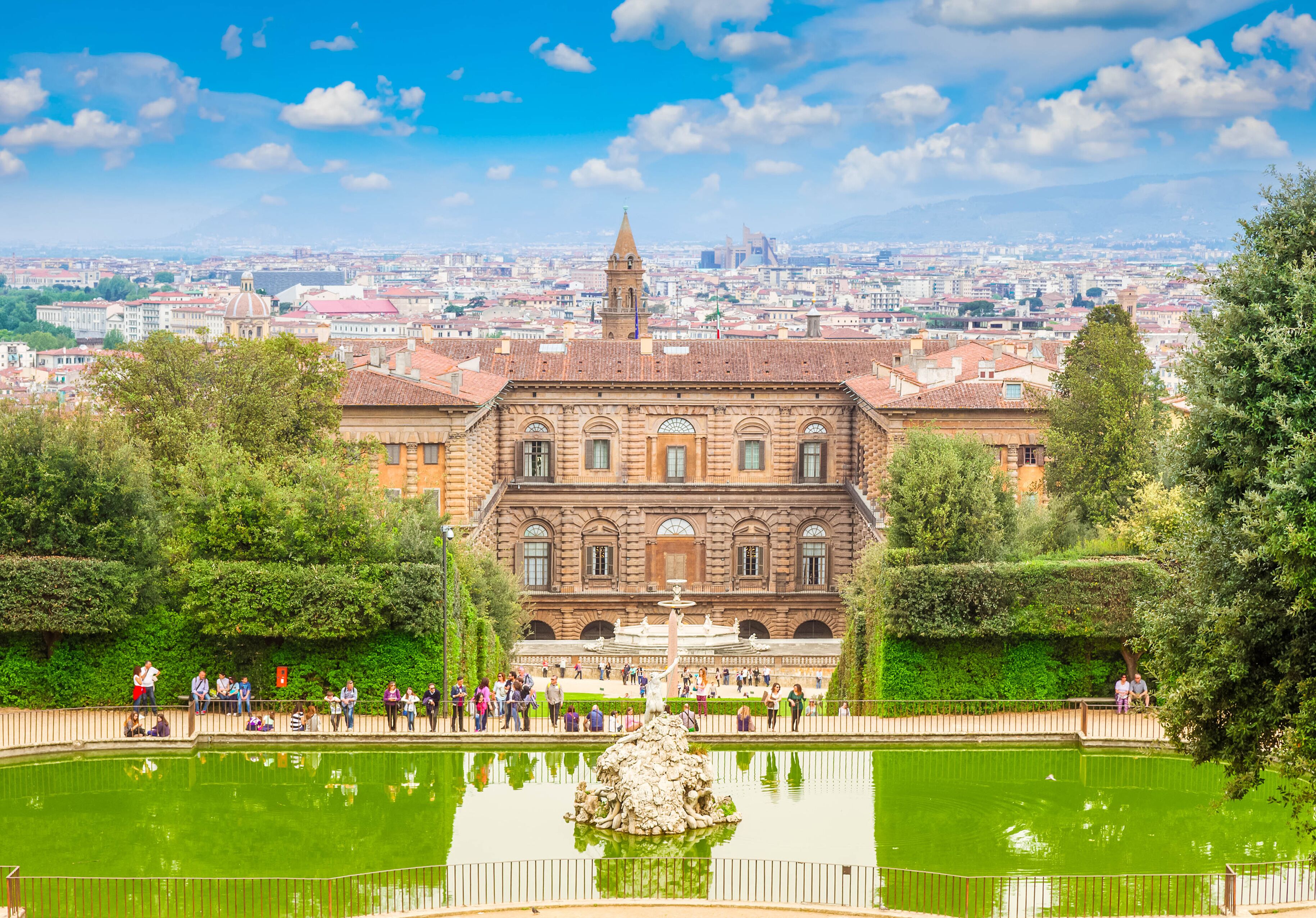
After Eleanor of Toledo’s purchase in 1549, Bartolomeo Ammannati enlarged the palace and created the monumental courtyard. The Medici used the building as a grand-ducal base and linked it to Boboli behind it.
What to notice
The courtyard reads as an architectural stage between the city and the garden.
03
1565
The Vasari Corridor tied the palace to Medici government
Giorgio Vasari built the corridor in 1565 to connect the Uffizi area to Pitti and Boboli. It made the palace part of a protected political route, not just a domestic one.
Important distinction
The corridor explains why Pitti belongs to a wider court system, not a single building.
04
17th century
Decorated rooms gave the palace its ceremonial look
The Palatine Gallery was arranged in former ceremonial rooms. Painters and decorators worked with carved frames, silk-covered walls, and furniture so the rooms felt like court spaces, not neutral galleries.
Visitor takeaway
The room is part of the display. It never behaves like a modern white museum.
05
1865–1871
Florence’s capital years gave Pitti a new royal role
When Florence served as capital of the Kingdom of Italy, Victor Emmanuel II and the Savoy court used Pitti Palace as a royal residence. The palace changed from dynastic seat to national stage.
What remains
Later furnishings and room changes still mark the Savoy period inside the palace.
06
1919
The Italian State received the palace, square, and gardens
Victor Emmanuel III donated Pitti Palace, Piazza Pitti, and Boboli Gardens to the Italian State in 1919. That decision fixed the estate as public heritage rather than a private royal seat.
Visitor takeaway
The modern museum role rests on a formal transfer of ownership, not a later invention.
07
2025–2026
Recent restoration changed how visitors read the interior
The Royal Apartments reopened in 2025 with timed access, and 2026 notices show active restoration in other parts of the palace. That means the visible route is still changing, even when the building feels settled.
Current distinction
What is open, closed, or under repair can shift the way the palace reads on the day.
Five dates worth remembering before you visit
You do not need to memorise every ruler, artist, or room name. These five dates explain why the palace feels like layered power, not one fixed home.